FIRST TIME BUYER ? - Use Code FIRSTTIME to enjoy 5% additional discount on entire store

What Causes Pigmentation on the Face? 8 Common Reasons Explained
Discover What Causes Pigmentation on the Face, including sun exposure, acne, hormones, and ageing. Learn how to prevent and reduce dark spots effectively.
6/27/20265 min read
What Causes Pigmentation on the Face? 8 Common Reasons Explained
Facial pigmentation develops when certain areas of your skin produce more melanin than normal. The most common causes include excessive sun exposure, acne, hormonal changes, skin inflammation, ageing, genetics, and some medications. While pigmentation is common, identifying its root cause is the first step toward choosing the right treatment and preventing new dark spots.
Key Takeaways
· Pigmentation is caused by excess melanin production.
· Sun exposure is the leading cause of facial pigmentation.
· Acne, hormones, and inflammation can leave dark marks behind.
· Daily sunscreen helps prevent existing pigmentation from worsening.
· Ingredients like Tranexamic Acid, Kojic Acid, Alpha Arbutin, and Niacinamide can help improve uneven skin tone over time.
· Consistency is more important than using multiple products.
Why Does Pigmentation Develop?
Your skin contains specialised cells called melanocytes, which produce melanin, the pigment responsible for your natural skin colour.
Melanin acts as your skin’s natural defence against ultraviolet (UV) radiation. Whenever your skin experiences stress—whether from sunlight, acne, irritation, or hormonal changes—melanocytes may become overactive and produce excess melanin.
Instead of spreading evenly, this extra pigment collects in specific areas, leading to dark spots, patches, or an uneven complexion.
The cause of pigmentation determines both its appearance and the most effective treatment.
1. Sun Exposure – The Most Common Cause
Repeated exposure to UV rays is the leading cause of facial pigmentation because it stimulates melanin production.
Your skin naturally produces more melanin when exposed to sunlight to protect itself from UV damage.
Over months and years, repeated exposure can lead to:
· Sunspots
· Uneven skin tone
· Dark patches
· Existing pigmentation becoming darker
Even if you stay indoors most of the day, UVA rays can pass through windows and continue triggering pigmentation.
Prevention Tips
· Apply SPF 50 broad-spectrum sunscreen every morning.
· Reapply every 2–3 hours when outdoors.
· Wear sunglasses, hats, or seek shade during peak sunlight hours.
2. Acne and Pimples
Acne often leaves behind dark marks after the pimple heals. This condition is known as Post-Inflammatory Hyperpigmentation (PIH).
Whenever a pimple causes inflammation, your skin may produce extra melanin during the healing process.
Unlike acne scars, these marks are flat and usually fade gradually with proper skincare.
People with Indian skin tones are particularly prone to PIH because their skin naturally contains more melanin.
3. Hormonal Changes (Melasma)
Hormonal fluctuations can trigger a type of pigmentation called melasma, which usually appears as symmetrical brown patches on the face.
Melasma commonly develops during:
· Pregnancy
· Birth control use
· Hormonal imbalance
· Menopause
It often affects the:
· Forehead
· Cheeks
· Nose
· Upper lip
Hormonal pigmentation usually requires long-term management along with strict sun protection.
4. Skin Inflammation or Injury
Any skin injury can stimulate melanin production while the skin heals.
Common triggers include:
· Cuts
· Burns
· Waxing
· Chemical peels
· Harsh exfoliation
· Allergic reactions
· Insect bites
Picking or scratching healing skin can increase the likelihood of pigmentation.
Gentle skincare helps reduce unnecessary inflammation.
5. Ageing
Years of accumulated sun exposure often become visible as pigmentation later in life.
As skin ages, repeated UV exposure causes pigment-producing cells to become less evenly distributed.
This can result in:
· Age spots
· Liver spots
· Uneven skin tone
Although ageing is natural, daily sunscreen can significantly reduce premature pigment changes.
6. Genetics
Some people are naturally more likely to develop pigmentation than others.
If close family members have melasma or persistent pigmentation, your risk may be higher.
People with medium to deeper skin tones also have a greater tendency to develop pigmentation after acne or inflammation because their melanocytes are naturally more active.
7. Certain Medications and Medical Conditions
Some medications increase your skin’s sensitivity to sunlight, making pigmentation more likely.
Examples include certain:
· Antibiotics
· Hormonal medications
· Anti-seizure medicines
Medical conditions involving hormones may also contribute to pigmentation.
If pigmentation develops suddenly after starting a new medication, consult your healthcare provider rather than stopping the medicine on your own.
8. Incorrect Skincare Routine
Many people unintentionally worsen pigmentation by damaging their skin barrier.
Common mistakes include:
· Over-exfoliating
· Using multiple strong acids together
· Using skincare without sunscreen
· Frequently changing products
· Picking at pimples
Healthy skin heals more efficiently, while irritated skin is more likely to develop pigmentation.
Can You Prevent Facial Pigmentation?
Although not every cause can be avoided, you can significantly reduce your risk by following a consistent skincare routine.
Focus on these habits:
· Wear sunscreen every day.
· Avoid picking pimples.
· Treat acne early.
· Introduce active ingredients gradually.
· Protect your skin from excessive sun exposure.
· Maintain a healthy skin barrier with gentle skincare.
Preventing pigmentation is often easier than treating it later.
Ingredients That May Help Improve Pigmentation
Different ingredients target pigmentation in different ways.
Some of the most commonly recommended include:
· Tranexamic Acid – Helps reduce pathways involved in excess melanin production.
· Kojic Acid – Helps inhibit tyrosinase, an enzyme involved in melanin formation.
· Alpha Arbutin – Supports a brighter, more even-looking complexion.
· Niacinamide – Helps reduce melanin transfer while supporting the skin barrier.
· Vitamin C – Provides antioxidant protection and helps improve overall skin radiance.
Because pigmentation often has multiple causes, products combining complementary ingredients may provide broader support than relying on a single active ingredient.
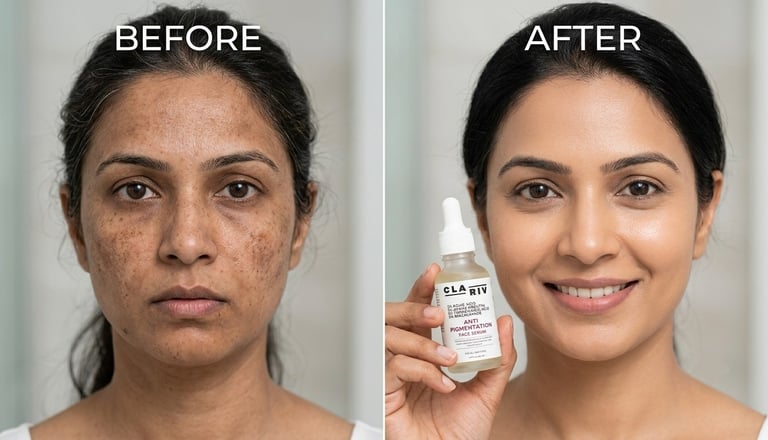
For example, CLARIV Anti Pigmentation Serum combines Tranexamic Acid, Kojic Acid, Alpha Arbutin, and Niacinamide in one formulation to target multiple pathways associated with uneven skin tone. Pairing it with CLARIV Sunscreen SPF 50 PA++++ each morning helps protect the skin from UV-induced pigmentation, while CLARIV 10% Vitamin C Serum can complement your routine by supporting brighter-looking skin and providing antioxidant protection.
When Should You See a Dermatologist?
Seek professional advice if:
· Pigmentation appears suddenly.
· Dark patches spread rapidly.
· Home skincare shows little improvement after several months.
· Pigmentation is accompanied by itching, bleeding, or pain.
· You are unsure whether the patches are melasma, sunspots, or another skin condition.
A dermatologist can identify the underlying cause and recommend an appropriate treatment plan.
Frequently Asked Questions
1. What is the biggest cause of pigmentation on the face?
Sun exposure is the most common cause because UV rays stimulate excess melanin production, leading to dark spots and uneven skin tone.
2. Can acne permanently cause pigmentation?
Acne usually causes post-inflammatory hyperpigmentation rather than permanent pigmentation. With consistent skincare and sun protection, these marks often fade over time.
3. Does stress cause pigmentation?
Stress does not directly create pigmentation, but it can worsen hormonal imbalances or acne, which may indirectly contribute to pigmentation.
4. Can pigmentation disappear naturally?
Some mild pigmentation may fade naturally, but deeper pigmentation often improves more effectively with targeted skincare and daily sunscreen.
5. Which ingredient is best for facial pigmentation?
There is no single best ingredient. A combination of Tranexamic Acid, Kojic Acid, Alpha Arbutin, Niacinamide, and Vitamin C is commonly used because each works through a different mechanism.
6. Is pigmentation common in Indian skin?
Yes. Indian skin is generally more prone to post-inflammatory hyperpigmentation due to its higher melanin content.
7. Can sunscreen reduce pigmentation?
Sunscreen helps prevent pigmentation from becoming darker and reduces the formation of new pigmentation. It is an essential part of any pigmentation treatment routine.
8. How long does pigmentation take to improve?
Many people notice gradual improvement within 8–12 weeks when using appropriate skincare consistently and protecting their skin from the sun every day.
9. Can hormones cause pigmentation on the face?
Yes. Hormonal changes can trigger melasma, which commonly appears on the forehead, cheeks, and upper lip.
10. Can over-exfoliation cause pigmentation?
Yes. Excessive exfoliation may damage the skin barrier, increase inflammation, and make post-inflammatory pigmentation more likely.
Conclusion
Facial pigmentation is usually the result of excess melanin production triggered by sun exposure, acne, hormonal changes, ageing, inflammation, genetics, or an impaired skin barrier. While the causes vary, the solution often begins with identifying the trigger, protecting your skin from UV damage, and using ingredients that target pigmentation at multiple levels.
Consistency is the key to visible improvement. A well-planned routine featuring Tranexamic Acid, Kojic Acid, Alpha Arbutin, Niacinamide, and daily sunscreen can help improve uneven skin tone over time.
If pigmentation is affecting your confidence, focus on science-backed ingredients rather than quick fixes. Combined with CLARIV Anti Pigmentation Serum, CLARIV Sunscreen SPF 50 PA++++, and CLARIV 10% Vitamin C Serum, a consistent skincare routine can support a healthier, brighter, and more even-looking complexion.
info@clariv.in
+91-92204-02087