FIRST TIME BUYER ? - Use Code FIRSTTIME to enjoy 5% additional discount on entire store

Pigmentation: Causes, Types, Prevention & Best Treatments (Complete Guide)
Learn what causes skin pigmentation, different types, prevention tips, and the best scientifically backed treatments for clearer, more even-toned skin.
6/27/20269 min read
Pigmentation: Causes, Types, Prevention & Best Treatments (Complete Guide)
Pigmentation is a common skin concern caused by excess melanin production, leading to dark spots or uneven skin tone. Sun exposure, acne, hormonal changes, inflammation, and ageing are among the most common triggers. While pigmentation usually takes weeks to months to improve, a combination of targeted skincare ingredients, daily sunscreen, and consistency can significantly reduce its appearance.
What is Pigmentation?
Pigmentation refers to the natural colouring of your skin, hair, and eyes. This colour comes from a pigment called melanin, which is produced by specialised skin cells known as melanocytes.
Melanin is actually your skin’s natural defence mechanism. It absorbs harmful ultraviolet (UV) rays and helps protect deeper layers of the skin from sun damage.
Problems begin when melanocytes start producing too much melanin in certain areas. Instead of an even complexion, this creates patches of darker skin, commonly known as hyperpigmentation.
Pigmentation can appear anywhere on the face or body, but it is most commonly seen on the cheeks, forehead, nose, upper lip, chin, neck, hands, and shoulders.
The good news is that most pigmentation concerns can be improved with the right skincare routine and sun protection.
What Causes Pigmentation?
Pigmentation is not caused by a single factor. Instead, it usually develops because multiple triggers stimulate excess melanin production.
The most common causes include:
1. Sun Exposure
Ultraviolet (UV) radiation is the biggest cause of pigmentation.
When your skin is exposed to sunlight, melanocytes increase melanin production to protect your skin from UV damage.
Over time, repeated sun exposure can lead to:
· Sun spots
· Uneven skin tone
· Freckles becoming darker
· Persistent pigmentation
This is why dermatologists consider sunscreen one of the most important steps in preventing pigmentation.
2. Acne and Skin Inflammation
Many people notice dark marks after pimples heal.
This is called Post-Inflammatory Hyperpigmentation (PIH).
When the skin becomes inflamed because of acne, cuts, burns, waxing, or even harsh skincare products, melanocytes may produce excess pigment during healing.
These dark marks often remain long after the original acne has disappeared.
3. Hormonal Changes
Hormonal fluctuations can also trigger pigmentation.
This commonly occurs during:
· Pregnancy
· Birth control use
· Hormonal disorders
· Menopause
Hormone-related pigmentation is often called melasma, and usually appears as symmetrical brown patches on the forehead, cheeks, and upper lip.
4. Ageing
As we grow older, years of accumulated sun exposure begin to show.
This often leads to:
· Age spots
· Liver spots
· Uneven skin tone
Although ageing itself is natural, protecting your skin from UV damage early can reduce these visible changes.
5. Genetics
Some individuals naturally produce more melanin than others.
People with medium to deeper skin tones are generally more prone to developing pigmentation after inflammation or sun exposure.
Having a family history of melasma or pigmentation may also increase your risk.
How Does Pigmentation Develop?
Understanding the science makes it easier to understand why pigmentation takes time to fade.
The process usually follows these steps:
1. Your skin experiences a trigger such as sunlight, acne, hormones, or irritation.
2. Melanocytes become activated.
3. They produce extra melanin.
4. Melanin is transferred into surrounding skin cells.
5. The affected area becomes visibly darker.
Because skin naturally renews itself over several weeks, pigmentation fades gradually—not overnight.
This is why consistent skincare is far more effective than constantly switching products.
Types of Pigmentation
Not every dark spot is the same.
Identifying the correct type helps you choose the most suitable skincare routine.
Post-Inflammatory Hyperpigmentation (PIH)
Usually develops after:
· Acne
· Burns
· Cuts
· Insect bites
· Skin irritation
These marks range from light brown to dark brown depending on your skin tone.
Melasma
Melasma is usually linked to hormonal changes and sun exposure.
It often appears as large patches across:
· Cheeks
· Forehead
· Nose
· Upper lip
Melasma generally requires long-term sun protection and targeted skincare.
Sunspots
Also known as solar lentigines, these develop after years of UV exposure.
They are most common on:
· Face
· Hands
· Shoulders
· Arms
Freckles
Freckles are small pigment spots that become darker after sun exposure.
Unlike sunspots, freckles often fade slightly during seasons with less sunlight.
Who Is More Likely to Develop Pigmentation?
Anyone can develop pigmentation, but certain factors increase the likelihood.
You may be at higher risk if you:
· Spend long hours outdoors.
· Have acne-prone skin.
· Frequently skip sunscreen.
· Have a medium to deeper skin tone.
· Experience hormonal fluctuations.
· Have a family history of melasma.
· Pick at pimples or skin injuries.
· Use irritating skincare products too often.
Knowing your risk factors can help you take preventive steps before pigmentation becomes more noticeable.
Can Pigmentation Be Prevented?
In many cases, yes. While genetics and hormones cannot always be controlled, several daily habits can help reduce the risk of developing new pigmentation.
The most effective preventive measures include:
· Wear a broad-spectrum sunscreen with SPF 50 or higher every morning, even on cloudy days.
· Reapply sunscreen every 2–3 hours when spending time outdoors.
· Avoid picking pimples or scratching healing skin.
· Introduce active ingredients gradually to reduce irritation.
· Wear hats or seek shade during peak sunlight hours.
· Follow a consistent skincare routine instead of changing products frequently.
Prevention is often easier than treating established pigmentation, especially when UV exposure is a major trigger.
Common Myths About Pigmentation
Myth 1: Pigmentation disappears on its own.
Some mild pigmentation may fade over time, but deeper pigmentation often requires consistent skincare and sun protection.
Myth 2: Only people with darker skin get pigmentation.
Pigmentation can affect every skin tone. However, medium to deeper skin tones are generally more prone to post-inflammatory pigmentation.
Myth 3: Expensive products always work faster.
Results depend on ingredients, formulation, consistency, and daily sunscreen use—not simply on price.
Myth 4: If pigmentation fades, sunscreen is no longer needed.
Without daily sun protection, pigmentation can return or become darker again.
Best Treatments for Pigmentation
The right treatment depends on the type and depth of pigmentation. While some dark spots fade naturally over time, others require targeted skincare and consistent sun protection.
Dermatologists generally recommend a combination of ingredients that reduce excess melanin production, improve skin cell turnover, and protect the skin from further UV damage.
The key to success is consistency. Most pigmentation treatments require at least 8–12 weeks of regular use before noticeable improvement.
Best Skincare Ingredients for Pigmentation
Not all skincare ingredients work the same way. Some slow melanin production, while others help fade existing pigmentation or prevent new dark spots from forming.
Tranexamic Acid
Tranexamic Acid has become one of the most recommended ingredients for stubborn pigmentation and melasma.
It works by interrupting pathways that stimulate excess melanin production, making it particularly useful for uneven skin tone and post-inflammatory pigmentation.
Suitable for:
· Melasma
· Acne marks
· Uneven skin tone
· Sun-induced pigmentation
Kojic Acid
Kojic Acid is well known for helping reduce the appearance of dark spots.
It works by inhibiting tyrosinase, the enzyme responsible for producing melanin. Less tyrosinase activity means less excess pigment is formed.
Suitable for:
· Dark spots
· Sunspots
· Acne marks
· Uneven complexion
Alpha Arbutin
Alpha Arbutin is a gentle skin-brightening ingredient that also targets tyrosinase.
Compared with some stronger depigmenting agents, it is generally well tolerated, making it suitable for many skin types.
Suitable for:
· Beginners
· Sensitive skin
· Mild to moderate pigmentation
Niacinamide
Niacinamide does more than brighten the skin.
It helps reduce the transfer of melanin from pigment-producing cells to skin cells while also strengthening the skin barrier and improving overall skin texture.
Suitable for:
· Oily skin
· Sensitive skin
· Pigmentation with enlarged pores
· Uneven skin tone
Vitamin C
Vitamin C is a powerful antioxidant that helps protect the skin against free radical damage caused by UV exposure and pollution.
It also supports a brighter complexion and complements pigment-correcting ingredients when used consistently.
A Simple Skincare Routine for Pigmentation
An effective routine doesn’t need dozens of products. Consistency is more important than complexity.
Morning Routine
1. Gentle cleanser
2. Vitamin C Serum (optional but beneficial)
3. Moisturiser (if required)
4. Broad-spectrum Sunscreen SPF 50 PA++++
Daily sunscreen is non-negotiable because UV exposure can trigger new pigmentation and make existing dark spots more noticeable.
Night Routine
1. Gentle cleanser
2. Pigmentation serum
3. Moisturiser (if needed)
Avoid introducing multiple active ingredients at once, especially if you have sensitive skin.
Why Sunscreen Is Essential for Pigmentation
Many people spend money on pigmentation serums but skip sunscreen.
Unfortunately, this often slows progress.
Even brief exposure to ultraviolet rays can stimulate melanin production, making dark spots appear darker again.
A broad-spectrum sunscreen with SPF 50 PA++++ helps protect the skin against UVA and UVB rays, reducing the risk of new pigmentation while supporting the results of your treatment routine.
For this reason, sunscreen should be used every day, regardless of the season or whether you’re indoors near windows for long periods.
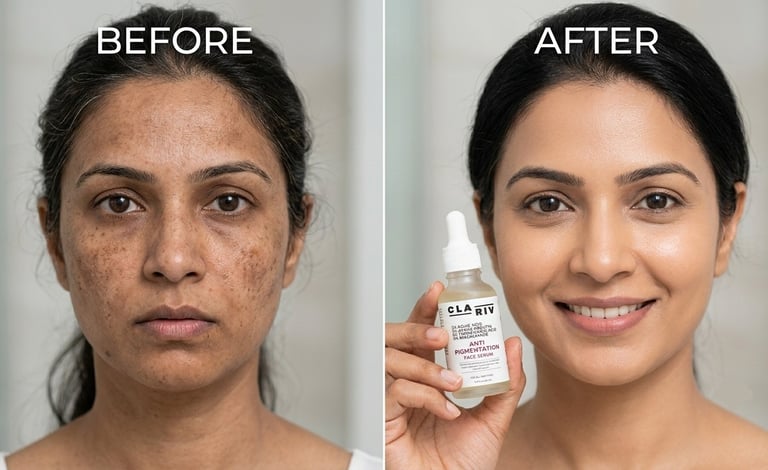
How CLARIV Anti Pigmentation Serum Fits Into This Routine
If you’re looking for a serum designed to target multiple causes of pigmentation, it helps to choose a formulation that combines complementary ingredients instead of relying on a single active.
CLARIV Anti Pigmentation Serum combines:
· Tranexamic Acid
· Kojic Acid
· Alpha Arbutin
· Niacinamide
Each ingredient works through a different mechanism, helping address uneven skin tone, post-acne marks, and visible pigmentation while supporting healthier-looking skin.
For daytime protection, pairing your pigmentation routine with CLARIV Sunscreen SPF 50 PA++++ helps minimise further UV-induced pigmentation. If dullness is also a concern, CLARIV 10% Vitamin C Serum can be incorporated into the morning routine to provide antioxidant support and promote a brighter complexion.
Remember that no skincare product can deliver overnight results. Improvement depends on the type of pigmentation, daily sun protection, and consistent use over time.
Common Mistakes That Can Slow Pigmentation Recovery
Avoiding these common mistakes can improve your chances of seeing better results.
· Skipping sunscreen because you’re indoors.
· Picking acne or scratching healing skin.
· Expecting visible improvement within a few days.
· Using too many active ingredients together.
· Frequently switching skincare products.
· Stopping treatment as soon as pigmentation begins to fade.
Healthy skin improves gradually, so patience is just as important as choosing the right ingredients.
How Long Does It Take to See Results?
Every person’s skin is different, but a realistic timeline is:
· 2–4 weeks: Skin may appear more hydrated and brighter.
· 6–8 weeks: Mild pigmentation and recent acne marks may begin to look lighter.
· 8–12 weeks: More noticeable improvement is often seen with consistent skincare and daily sunscreen.
· Beyond 12 weeks: Stubborn pigmentation, including melasma, may require longer-term management and, in some cases, professional treatment.
Consistency usually delivers better results than using stronger products for a short period.
When Should You See a Dermatologist?
While many forms of pigmentation can be managed with skincare, professional advice is recommended if:
· Pigmentation appears suddenly without an obvious cause.
· Dark patches continue to spread rapidly.
· The affected area changes in shape, colour, or texture.
· Pigmentation is accompanied by pain, bleeding, or persistent irritation.
· Home skincare has not improved the condition after several months.
A dermatologist can identify the underlying cause and recommend treatments that are appropriate for your skin.
Frequently Asked Questions
1. Can pigmentation be removed permanently?
Some forms of pigmentation can fade significantly, but conditions like melasma may recur, especially with continued sun exposure or hormonal changes. Daily sunscreen and a consistent skincare routine help reduce the risk of recurrence.
2. Which ingredient is best for pigmentation?
There is no single “best” ingredient for everyone. Ingredients such as Tranexamic Acid, Kojic Acid, Alpha Arbutin, Niacinamide, and Vitamin C each work differently and are often more effective when used together as part of a well-designed routine.
3. Can sunscreen reduce pigmentation?
Sunscreen does not remove existing pigmentation, but it plays a vital role in preventing it from becoming darker and reducing the formation of new pigmentation.
4. Is pigmentation the same as dark spots?
Not always. Dark spots are one form of pigmentation, but pigmentation also includes conditions such as melasma, sunspots, and post-inflammatory hyperpigmentation.
5. Can acne cause pigmentation?
Yes. After inflammation from acne heals, excess melanin may remain in the affected area, leading to post-inflammatory hyperpigmentation.
6. Is pigmentation more common in Indian skin?
People with medium to deeper skin tones are generally more prone to developing pigmentation after acne, irritation, or sun exposure because their skin naturally produces more melanin.
7. Can I use Vitamin C and a pigmentation serum together?
Yes. Vitamin C is commonly used in the morning for antioxidant protection, while a pigmentation serum is often applied at night. Always introduce new active ingredients gradually if you have sensitive skin.
8. How long does pigmentation take to fade?
Recent pigmentation may begin improving within 6–8 weeks, while deeper or long-standing pigmentation can take several months of consistent care.
9. Can pigmentation return after treatment?
Yes. Without regular sun protection, new UV exposure or hormonal changes may trigger pigmentation again. Maintenance skincare and sunscreen are important for long-term results.
10. What is the most important step in a pigmentation routine?
Daily sunscreen. Even the most advanced pigmentation serum cannot perform at its best if the skin continues to receive unprotected UV exposure.
Conclusion
Pigmentation is one of the most common skin concerns, but it is also one that responds well to a consistent, science-based skincare routine. Understanding what causes pigmentation—whether it is sun exposure, acne, hormones, or ageing—helps you choose treatments that address the root of the problem rather than simply covering it up.
Ingredients such as Tranexamic Acid, Kojic Acid, Alpha Arbutin, Niacinamide, and Vitamin C each play a unique role in improving uneven skin tone. Combined with daily SPF 50 sunscreen and realistic expectations, they can help support a brighter, more even-looking complexion over time.
If you’re building a pigmentation-focused skincare routine, choose products based on their ingredients rather than marketing claims. A formulation like CLARIV Anti Pigmentation Serum, paired with CLARIV Sunscreen SPF 50 PA++++ and supported by CLARIV 10% Vitamin C Serum during the day, offers a routine built around ingredients commonly recommended for pigmentation-prone skin.
Healthy skin is a long-term commitment. Stay consistent, protect your skin from the sun every day, and allow your skincare routine enough time to work.
info@clariv.in
+91-92204-02087